 Espiral Atlas
Acromion
acromion
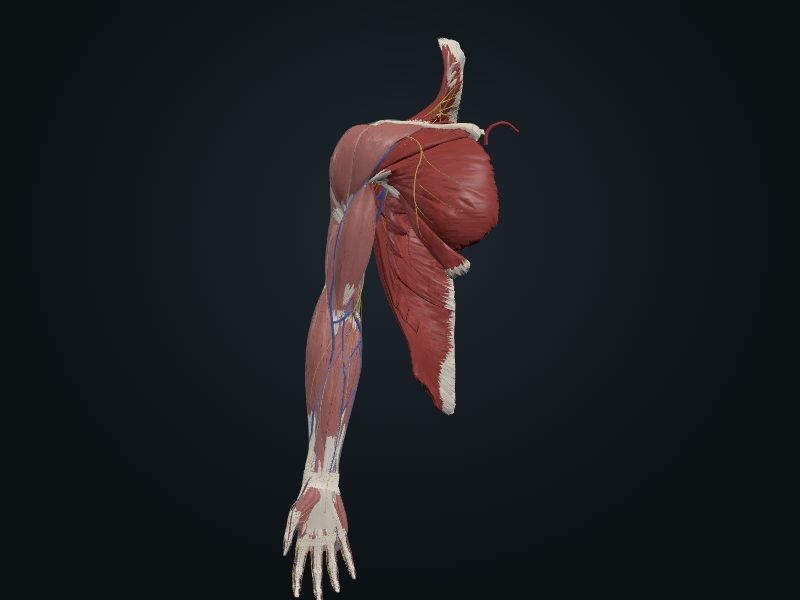
Study entry
Description
Flat expansion that continues the spine of the scapula outward; the highest subcutaneous point of the shoulder.
Relations
Articulates with the clavicle (acromioclavicular); origin of the acromial part of the deltoid and insertion of the trapezius.
Source: cap. 3, «Huesos del miembro superior: escápula»
Clinical correlation
Fracture of the scapula
It requires strong trauma (being hit by a vehicle, for example) and usually comes with rib fractures. Because the scapula is covered with muscle on both sides, it almost always needs little treatment. The part that breaks most is the acromion, which lies under the skin.
Acromioclavicular dislocation ("shoulder separation")
The coracoclavicular ligament is strong, but the joint itself is weak and is injured by a direct blow: a hard fall on the shoulder or the hand in rugby, football, hockey and fighting sports, or a strong blow to the upper back. It is serious when the acromioclavicular and coracoclavicular ligaments rupture: the shoulder separates from the clavicle and drops with the weight of the limb, the capsule tears and the acromion may pass under the tip of the clavicle. The clavicle stands out on top.
Calcific tendinitis of the supraspinatus and painful arc
Calcium deposits in the supraspinatus tendon are common: they increase local pressure and cause severe pain on abducting the arm, which may reach the hand. The calcium may irritate the subacromial bursa, just below, and inflame it (subacromial bursitis). With the arm adducted it does not hurt, because the lesion lies far from the acromion. In most, it hurts between 50° and 130° of abduction (painful arc syndrome), when the tendon touches the inferior surface of the acromion. It is typical of men from 50 on after excessive or unusual use of the shoulder.
Related clinical cases
- Fracture of the scapula
- Acromioclavicular dislocation ("shoulder separation")
- Calcific tendinitis of the supraspinatus and painful arc