 Espiral Atlas
Radial groove
sulcus nervi radialis
Study entry
Description
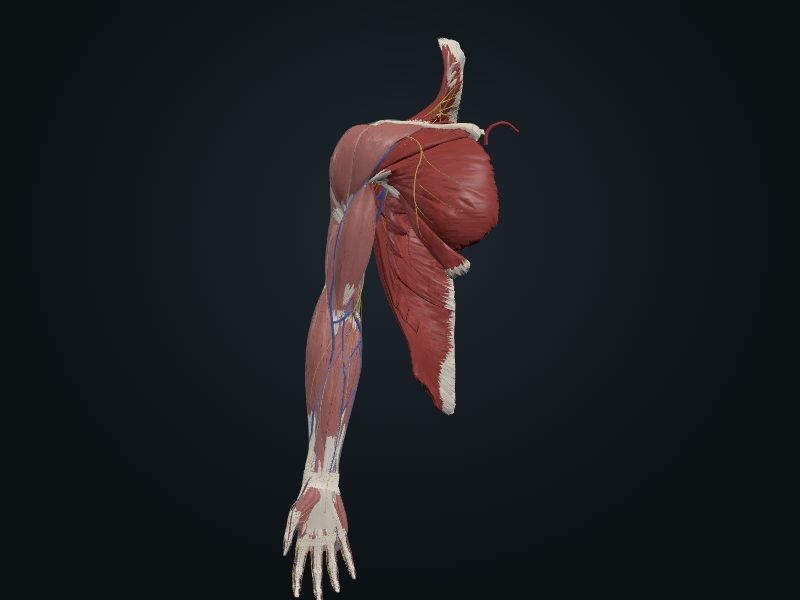
Oblique groove on the posterior surface of the shaft of the humerus.
Relations
The radial nerve and the deep brachial artery pass through it, between the origins of the lateral (above) and medial (below) heads of the triceps.
Clinical
In a fracture of the shaft of the humerus, the radial nerve is injured here.
Source: cap. 3, «Huesos del miembro superior: húmero»
Clinical correlation
Nerve injury in fracture of the shaft of the humerus; supracondylar fracture
A fracture of the middle of the humerus may injure the radial nerve in the radial groove; the triceps hardly stops, because the nerves to two of its heads leave above. A fracture near the supraepicondylar ridges (supracondylar) may displace the distal fragment forward or backward; the brachialis and the triceps pull it over the proximal one and shorten the limb, and the fragments may wound the neighboring brachial nerves and vessels.
Injury to the radial nerve in the arm: wrist drop
Injured above the branches to the triceps, the radial nerve paralyzes the triceps, brachioradialis, supinator and the extensors of the wrist and fingers, and removes sensation from the skin it supplies. Injured in the radial groove, the triceps only weakens (it loses the medial head), but the muscles of the posterior compartment of the forearm stop. The typical sign is wrist drop: the wrist and the fingers at the metacarpophalangeal joints cannot be extended, and the relaxed wrist stays half flexed from the tone of the flexors and from gravity.
Related clinical cases
- Nerve injury in fracture of the shaft of the humerus; supracondylar fracture
- Injury to the radial nerve in the arm: wrist drop