 Espiral Atlas
Medial epicondyle of the humerus
epicondylus medialis humeri
Study entry
Description
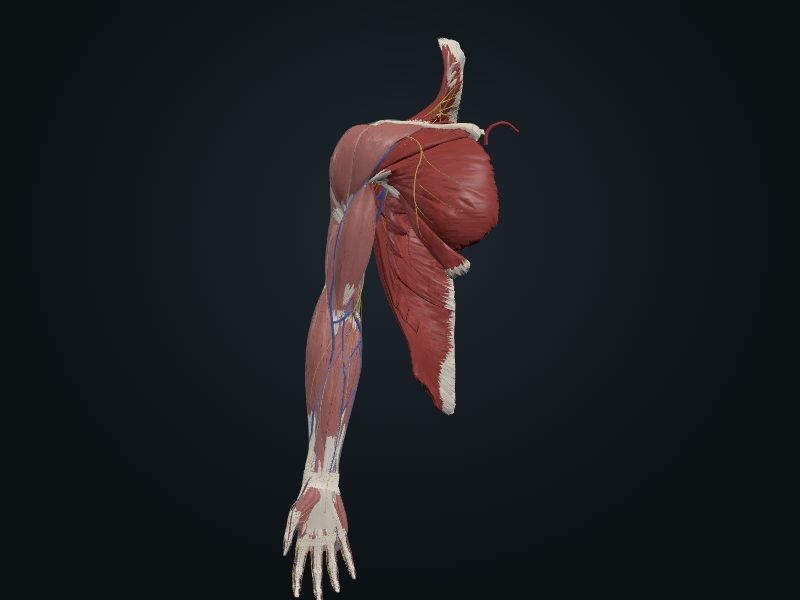
Subcutaneous knob-like prominence on the medial surface of the distal end of the humerus; more prominent than the lateral one.
Relations
Common origin of the forearm flexors; the ulnar nerve passes behind it.
Source: cap. 3, «Huesos del miembro superior: húmero»
Clinical correlation
Injury to the ulnar nerve at the elbow and forearm; cubital tunnel syndrome; claw hand
More than 27% of nerve injuries of the upper limb are of the ulnar. The typical sites are: behind the medial epicondyle (the most common, when the medial side of the elbow is struck and the epicondyle breaks), under the arch that joins the heads of the flexor carpi ulnaris (cubital tunnel syndrome, with the same signs), at the wrist and in the hand. Injury above the epicondyle gives tingling in the middle of the dorsum of the hand. There is generally numbness and tingling in the medial part of the palm, the little finger and the medial half of the ring finger; pressing the nerve behind the elbow reproduces this.
Avulsion of the medial epicondyle
In a child, a fall that forces abduction of the extended elbow makes the ulnar collateral ligament tear the medial epicondyle off downward. This is possible because the epiphysis of the medial epicondyle may only fuse to the humerus by 20 (on radiograph, generally at 14 in girls and 16 in boys). A common complication: stretching of the ulnar nerve, which passes behind the epicondyle.
Reconstruction of the ulnar collateral ligament ("Tommy John")
Ruptures and sprains of the ulnar collateral ligament are increasingly common in throwers (baseball, rugby, javelin, water polo). The reconstruction uses a long tendon from the person themself, from the forearm of the other side or from the leg (palmaris longus or plantaris): 10 to 15 cm of tendon pass through holes in the medial epicondyle of the humerus and in the side of the coronoid process of the ulna.
Related clinical cases
- Injury to the ulnar nerve at the elbow and forearm; cubital tunnel syndrome; claw hand
- Avulsion of the medial epicondyle
- Reconstruction of the ulnar collateral ligament ("Tommy John")