 Espiral Atlas
Surgical neck of the humerus
collum chirurgicum humeri
Study entry
Description
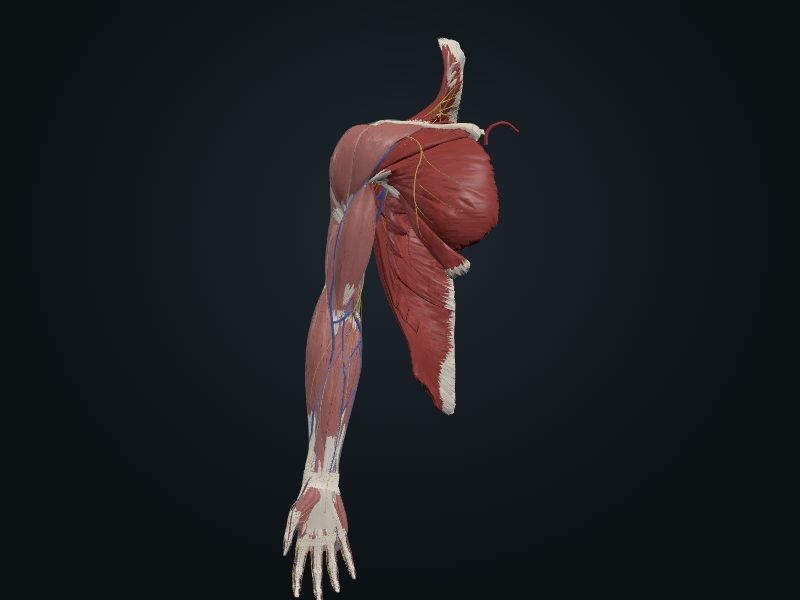
Narrow part just below the head and the tubercles.
Relations
Frequent site of fracture; the axillary nerve and the posterior circumflex humeral artery wind around it.
Source: cap. 3, «Huesos del miembro superior: húmero»
Clinical correlation
Fractures of the humerus
At the proximal end, most are of the surgical neck, typical of the elderly person with osteoporosis after a light fall on the hand; often one fragment is driven into the other (impacted fracture) and the arm still moves with little pain. The greater tubercle may be torn off (avulsion), generally with dislocation of the shoulder; the subscapularis, which stays attached, rotates the arm medially. In the shaft, a direct blow or a twist causes varied fractures: in a transverse one, the deltoid pulls the proximal fragment outward; a fall on the hand may cause a spiral fracture, and the oblique ends overlap and shorten the arm.
Injury to the axillary nerve
The axillary nerve (C5–C6) passes below the head of the humerus and winds around the surgical neck, so it is usually injured in fractures of that part, in dislocation of the shoulder and by compression from a badly used crutch. The deltoid atrophies: the shoulder loses its rounded contour and a depression appears below the acromion. Sensation may be lacking on the lateral surface of the upper part of the arm (superior lateral brachial cutaneous nerve). Because it runs transversely under the deltoid at the level of the surgical neck, it must be kept in mind in intramuscular injection and in surgical approaches to the shoulder.
Related clinical cases
- Fractures of the humerus
- Injury to the axillary nerve