 Espiral Atlas
Lumbosacral joints
articulationes lumbosacrales
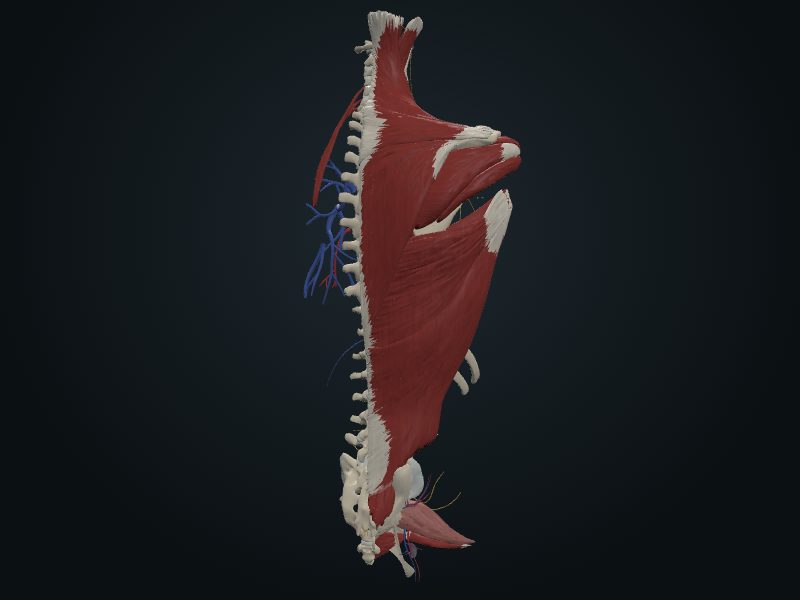
Study entry
Classification
One intervertebral joint (symphysis, through the L5–S1 disc) between the bodies and two zygapophysial joints (plane synovial) between the articular processes.
Surfaces
Body of L5 with the base of the sacrum, through the L5–S1 disc; inferior articular processes of L5, facing forward and outward, with the superior processes of S1, facing backward and inward.
Capsule
The fit of the articular processes prevents L5 from slipping forward on the inclined sacrum. The iliolumbar ligaments, fan-shaped, run from the transverse processes of L5 to both ilia and reinforce the joint.
Movements
Those of the lumbar spine; the inclination of the sacrum tends to make L5 slide forward.
Blood supply
Branches of the segmental arteries of the region: lumbar and iliolumbar, and lateral and median sacral, which supply the bones, the ligaments and the meninges of the segment.
Innervation
The disc and ligaments receive meningeal (recurrent) branches of the spinal nerves; the zygapophysial joints, articular branches from the medial branches of the posterior rami of the adjacent nerves.
Clinical
In spondylolysis of L5 (a defect of the pars interarticularis), the fit is lost and the body of L5 can slide forward over the sacrum (spondylolisthesis), narrowing the pelvic inlet. [CHECK: the OCR cuts off the rest of the sentence, which talks about compression]
Source: cap. 6, «Articulaciones lumbosacras» (figs. 6-4 A e 6-6); cap. 2, cuadro clínico «Espondilólisis y espondilolistesis»; «Vascularización de la columna vertebral» e «Nervios de la columna vertebral»