 Espiral Atlas
Clavicle
clavicula
Study entry
Parts
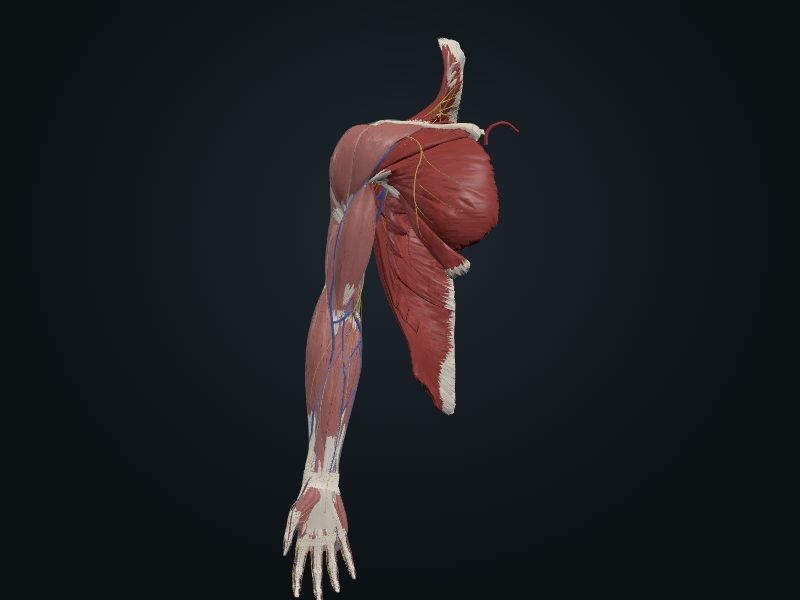
Sternal end (medial, robust) and acromial end (lateral, flattened); S-shaped shaft, convex forward in the medial two thirds and concave in the lateral third; on the inferior surface, the impression for the costoclavicular ligament, the groove for the subclavius muscle and the conoid tubercle.
Joints
Sternoclavicular (with the manubrium and the 1st costal cartilage) and acromioclavicular (with the acromion).
Palpation
Palpable along its whole length, under the skin.
Clinical
One of the bones that fracture most often, generally between the middle and lateral thirds, from a fall on the outstretched hand or the shoulder: the medial fragment rises (sternocleidomastoid) and the lateral one drops (weight of the limb).
Source: cap. 3, «Huesos del miembro superior: clavícula» y cuadro clínico
Clinical correlation
Fracture of the clavicle
It is one of the most common fractures, above all in children: a fall on the outstretched hand sends the force up the arm to the shoulder. The weak point is the junction of the middle and lateral thirds. The sternocleidomastoid pulls the medial fragment upward, and it stands out under the skin; the trapezius does not support the weight of the limb, so the lateral fragment and the shoulder drop, and the pectoralis major still pulls it inward. The fragments overlap and the clavicle shortens. A sling takes the weight off the limb and helps healing. In a newborn with broad shoulders it may break during delivery; in a young child it is usually a greenstick fracture.
Ossification of the clavicle (false fracture)
The clavicle is the first long bone to ossify (5th–6th week, intramembranous ossification in the shaft). The sternal epiphysis is the last of the long bones to fuse, between 18 and 31 years. Sometimes the two centers of the shaft do not unite and a gap remains between the medial and lateral thirds, which mimics a fracture; since it is usually bilateral, radiographing both clavicles settles the doubt.
Dislocation and ankylosis of the sternoclavicular joint
Dislocation is rare, because ligaments, disc and the way force runs along the clavicle make the joint strong: in a blow to the acromion or a fall on the hand, it is easier for the clavicle to break (between the middle and lateral thirds). Before 25, most "dislocations" are in fact a fracture through the epiphysial plate, which at the sternal end of the clavicle only closes between 23 and 25. Movement at this joint is essential for the shoulder: if it stiffens (ankylosis), a stretch from the middle of the clavicle is removed, creating a false joint that lets the scapula move.
Related clinical cases
- Fracture of the clavicle
- Ossification of the clavicle (false fracture)
- Dislocation and ankylosis of the sternoclavicular joint