 Espiral Atlas
Humerus
humerus
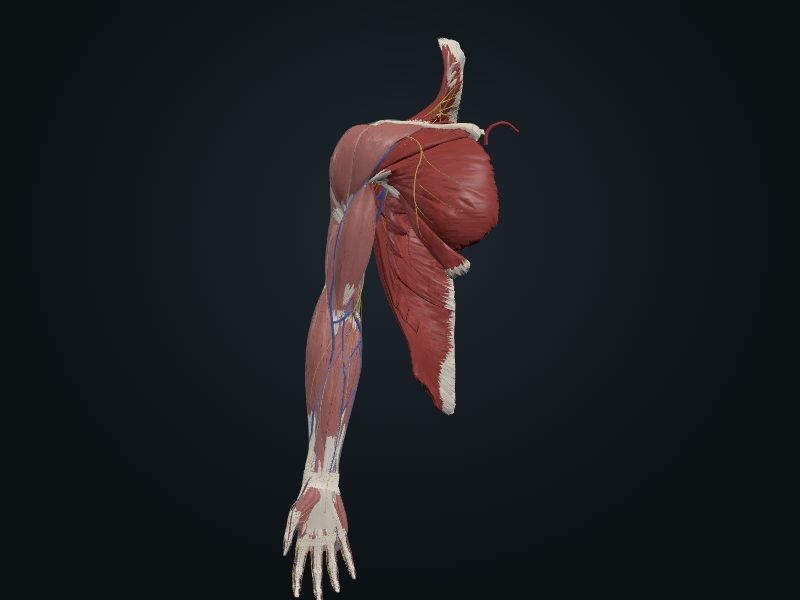
Study entry
Parts
Proximal: head, anatomical neck, greater and lesser tubercles separated by the intertubercular sulcus, surgical neck. Shaft: deltoid tuberosity and radial groove. Distal: medial and lateral epicondyles, supraepicondylar ridges, capitulum (with the radius), trochlea (with the ulna), coronoid, radial and olecranon fossae.
Joints
Glenohumeral (shoulder) and elbow (humeroulnar and humeroradial).
Palpation
Greater tubercle, medial and lateral epicondyles.
Clinical
Each fracture has its nerve at risk: surgical neck, axillary; shaft (groove), radial; supracondylar, median and brachial artery; medial epicondyle, ulnar.
Source: cap. 3, «Huesos del miembro superior: húmero» y cuadro clínico
Clinical correlation
Fractures of the humerus
At the proximal end, most are of the surgical neck, typical of the elderly person with osteoporosis after a light fall on the hand; often one fragment is driven into the other (impacted fracture) and the arm still moves with little pain. The greater tubercle may be torn off (avulsion), generally with dislocation of the shoulder; the subscapularis, which stays attached, rotates the arm medially. In the shaft, a direct blow or a twist causes varied fractures: in a transverse one, the deltoid pulls the proximal fragment outward; a fall on the hand may cause a spiral fracture, and the oblique ends overlap and shorten the arm.
Fracture-dislocation of the proximal epiphysis of the humerus
In a child or adolescent, a blow to the shoulder may separate the proximal epiphysis of the humerus, because the capsule of the shoulder joint, reinforced by the rotator cuff, is stronger than the epiphysial plate. In severe cases the shaft of the humerus is displaced a lot, but the head remains in place, in the glenoid cavity.
Nerve injury in fracture of the shaft of the humerus; supracondylar fracture
A fracture of the middle of the humerus may injure the radial nerve in the radial groove; the triceps hardly stops, because the nerves to two of its heads leave above. A fracture near the supraepicondylar ridges (supracondylar) may displace the distal fragment forward or backward; the brachialis and the triceps pull it over the proximal one and shorten the limb, and the fragments may wound the neighboring brachial nerves and vessels.
Related clinical cases
- Fractures of the humerus
- Fracture-dislocation of the proximal epiphysis of the humerus
- Nerve injury in fracture of the shaft of the humerus; supracondylar fracture