 Espiral Atlas
Fibula
fibula
Study entry
Parts
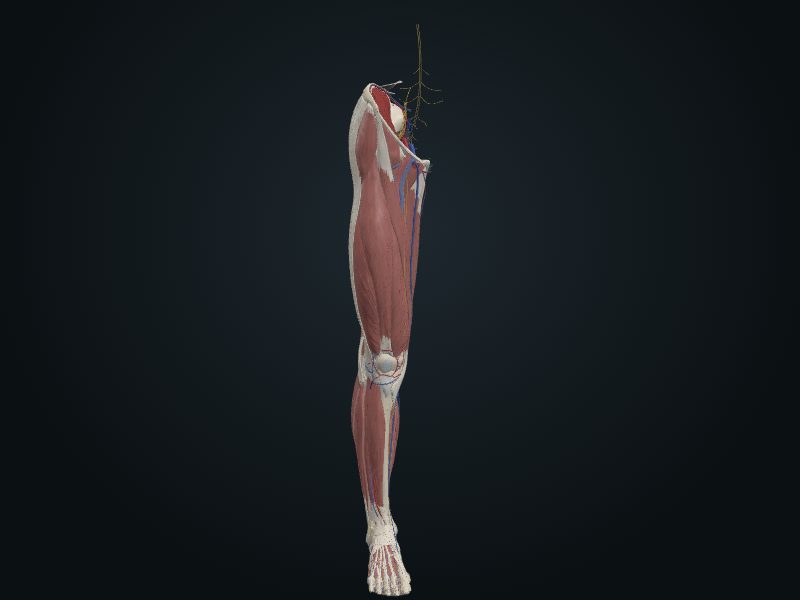
A thin bone, posterolateral to the tibia and attached to it by the tibiofibular syndesmosis; it does not bear weight and serves mainly as an attachment for muscles (insertion of one and origin of eight). Proximal end: head with a pointed apex, on a short neck. Twisted shaft, with a triangular cross-section, with three borders (anterior, interosseous and posterior). Distal end: the lateral malleolus.
Joints
Proximal tibiofibular (head with the lateral condyle of the tibia); tibiofibular syndesmosis (interosseous membrane and distal end in the fibular notch); talocrural (lateral malleolus with the talus).
Palpation
The head, on the posterolateral surface of the knee, at the level of the top of the tibial tuberosity; the neck, just below (palpation may be uncomfortable because of a nerve); the distal quarter of the shaft and the lateral malleolus, under the skin.
Source: cap. 7, «Huesos del miembro inferior: fíbula» y «Anatomía de superficie de la tibia y la fíbula»
Clinical correlation
Fractures of the fibula
The fibula usually breaks 2 to 6 cm above the tip of the lateral malleolus, often together with a fracture-dislocation of the ankle and a fracture of the tibia. When a person slips and the foot turns in exaggerated inversion, the ligaments of the ankle tear and the talus strikes the lateral malleolus and cuts it off. Fractures of both malleoli are common in soccer and basketball. It hurts because muscle attachments are torn, and walking gets worse because the fibula stabilizes the ankle.
Fibular bone graft
When an important segment of bone is lost to injury or disease, a bone graft can avoid amputation. The fibula is a common source: even without part of the shaft, the person walks, runs and jumps normally. The free vascularized fibular graft replaces bone in congenital anomalies, after trauma or tumor removal, in the upper and lower limbs. The removed part does not grow back, because the periosteum and nutrient artery go with the graft to keep it alive; in the new site it supplies the recipient bone and heals as if there were a fracture at each end.
Related clinical cases
- Fractures of the fibula
- Fibular bone graft