 Espiral Atlas
Acromioclavicular joint
articulatio acromioclavicularis
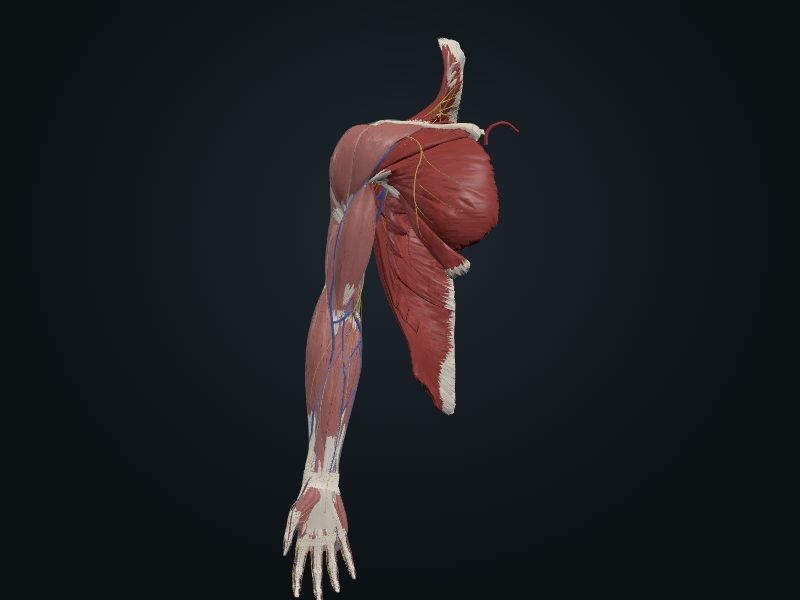
Study entry
Classification
Plane synovial joint, 2–3 cm from the highest point of the shoulder.
Surfaces
Acromial end of the clavicle with the acromion; fibrocartilage surfaces separated by an articular disc.
Capsule
Sleeve-like capsule, lax, reinforced on top by fibers of the trapezius and by the acromioclavicular ligament. Stability comes from the extrinsic coracoclavicular ligament, with two parts: conoid (vertical, to the conoid tubercle) and trapezoid (almost horizontal, to the trapezoid line).
Movements
The acromion rotates on the clavicle, following the movements of the scapula over the thorax; no muscle crosses the joint.
Blood supply
Suprascapular and thoracoacromial arteries.
Innervation
Lateral pectoral and axillary nerves and, because it is subcutaneous, also the lateral supraclavicular nerve.
Clinical
Dislocation ("shoulder separation") from a fall on the shoulder in contact sports; it is serious when the acromioclavicular and coracoclavicular ligaments rupture, and then the shoulder drops and the acromion becomes prominent.
Source: cap. 3, «Articulaciones del miembro superior: articulación acromioclavicular» y cuadro clínico
Clinical correlation
Fracture of the clavicle
It is one of the most common fractures, above all in children: a fall on the outstretched hand sends the force up the arm to the shoulder. The weak point is the junction of the middle and lateral thirds. The sternocleidomastoid pulls the medial fragment upward, and it stands out under the skin; the trapezius does not support the weight of the limb, so the lateral fragment and the shoulder drop, and the pectoralis major still pulls it inward. The fragments overlap and the clavicle shortens. A sling takes the weight off the limb and helps healing. In a newborn with broad shoulders it may break during delivery; in a young child it is usually a greenstick fracture.
Acromioclavicular dislocation ("shoulder separation")
The coracoclavicular ligament is strong, but the joint itself is weak and is injured by a direct blow: a hard fall on the shoulder or the hand in rugby, football, hockey and fighting sports, or a strong blow to the upper back. It is serious when the acromioclavicular and coracoclavicular ligaments rupture: the shoulder separates from the clavicle and drops with the weight of the limb, the capsule tears and the acromion may pass under the tip of the clavicle. The clavicle stands out on top.
Related clinical cases
- Fracture of the clavicle
- Acromioclavicular dislocation ("shoulder separation")