 Espiral Atlas
Shoulder (glenohumeral) joint
articulatio humeri
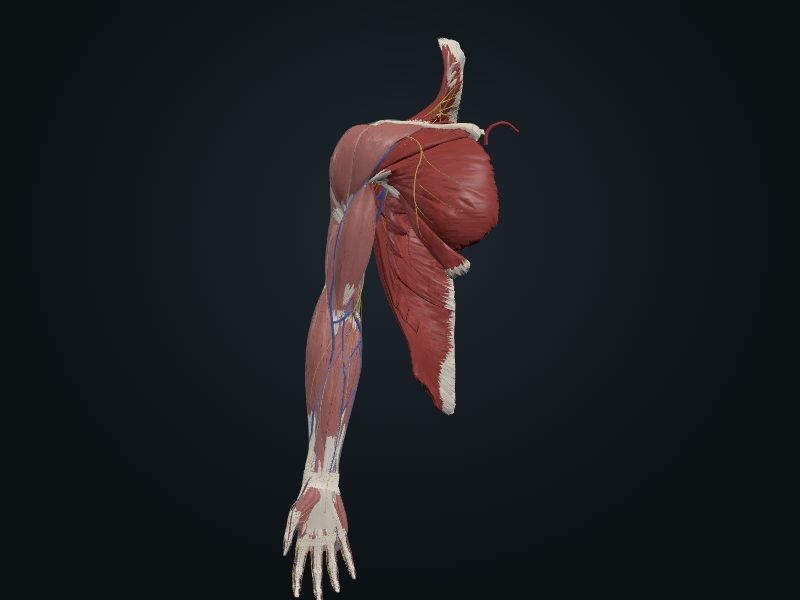
Study entry
Classification
Ball-and-socket synovial joint; the most mobile in the body and, for that reason, relatively unstable.
Surfaces
Head of the humerus with the glenoid cavity, which receives a little over a third of the head and is deepened by the glenoid labrum (fibrocartilage).
Capsule
Lax capsule, from the rim of the glenoid cavity to the anatomical neck of the humerus; it has an opening for the tendon of the long head of the biceps and another that communicates with the subscapular bursa. The inferior part, without reinforcement from the rotator cuff, is the weakest. Reinforcements: glenohumeral ligaments (three, on the inner anterior surface), coracohumeral (above) and transverse humeral (closes the intertubercular sulcus). The coracoacromial arch (acromion, coracoid and coracoacromial ligament) keeps the head from rising.
Movements
Flexion and extension, abduction and adduction, medial and lateral rotation, circumduction. Lateral rotation of the humerus increases abduction. In full elevation, about 120° come from the shoulder and 60° from the scapula (scapulohumeral rhythm, 2:1).
Blood supply
Anterior and posterior circumflex humeral arteries and branches of the suprascapular.
Innervation
Suprascapular, axillary and lateral pectoral nerves.
Clinical
Frequent dislocation, almost always anteroinferior (forced extension and lateral rotation), with risk to the axillary nerve. Rotator cuff injuries cause pain between 50° and 130° of abduction (painful arc); "frozen shoulder" (adhesive capsulitis) between 40 and 60 years.
Source: cap. 3, «Articulaciones del miembro superior: articulación del hombro» y cuadro clínico
Clinical correlation
Rotator cuff injuries
Trauma or degeneration may rupture one or more tendons of the cuff, and the shoulder becomes unstable. The tendon most often injured is that of the supraspinatus. Degenerative tendinitis of the cuff is common, above all in the elderly.
Calcific tendinitis of the supraspinatus and painful arc
Calcium deposits in the supraspinatus tendon are common: they increase local pressure and cause severe pain on abducting the arm, which may reach the hand. The calcium may irritate the subacromial bursa, just below, and inflame it (subacromial bursitis). With the arm adducted it does not hurt, because the lesion lies far from the acromion. In most, it hurts between 50° and 130° of abduction (painful arc syndrome), when the tendon touches the inferior surface of the acromion. It is typical of men from 50 on after excessive or unusual use of the shoulder.
Rotator cuff tear and the drop arm test
The cuff is injured by repeated use of the arm above the horizontal (throwing, racket sports, swimming, weightlifting). Repeated inflammation, above all in the poorly vascularized area of the supraspinatus tendon, causes pain and tears. In the thrower, the head of the humerus and the cuff strike the coracoacromial arch and degenerative tendinitis appears. Test: the person slowly lowers the fully abducted arm; from about 90°, it drops if the cuff (above all the supraspinatus) is injured. In an elderly person, a sudden effort (opening a stuck window) or a fall on the shoulder tears an already worn cuff.
Dislocation of the shoulder
Because it is very mobile and unstable, the shoulder dislocates often. The coracoacromial arch and the cuff prevent exit upward, so the head of the humerus comes out downward, but the dislocation is called anterior or posterior (rare) according to whether it descends in front of or behind the infraglenoid tubercle and the long head of the triceps. The anterior is the most common, in young adults and athletes, from excessive extension and lateral rotation: the capsule and the glenoid labrum may be torn from the front of the glenoid cavity. With the arm fully abducted, a blow drives the head onto the low, weak part of the capsule.
Related clinical cases
- Rotator cuff injuries
- Calcific tendinitis of the supraspinatus and painful arc
- Rotator cuff tear and the drop arm test
- Dislocation of the shoulder
- Injury to the glenoid labrum