 Espiral Atlas
Sternoclavicular joint
articulatio sternoclavicularis
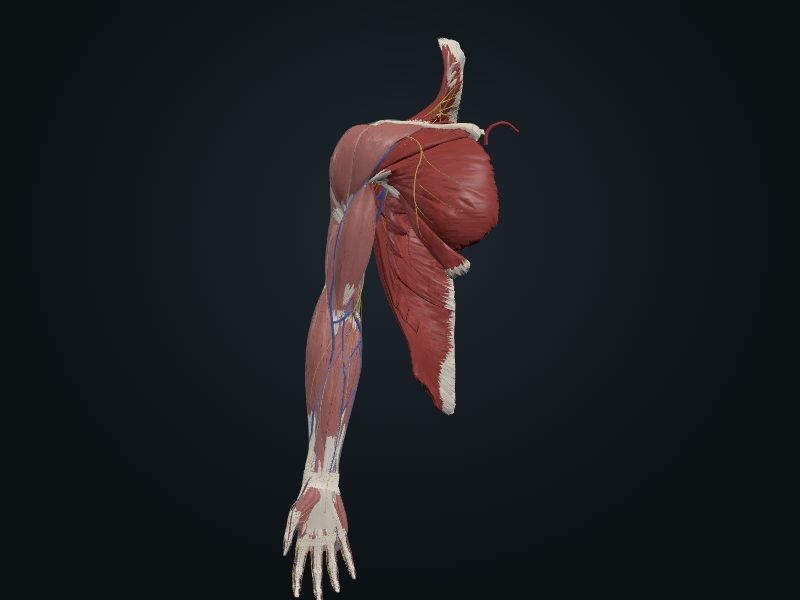
Study entry
Classification
Saddle synovial joint that functions as a ball-and-socket. An articular disc divides it into two compartments.
Surfaces
Sternal end of the clavicle with the manubrium of the sternum and the 1st costal cartilage; surfaces covered with fibrocartilage.
Capsule
Capsule attached to the margins of the articular surfaces and to the periphery of the disc. Reinforcements: anterior and posterior sternoclavicular ligaments, the interclavicular ligament (above, from one clavicle to the other) and the costoclavicular ligament, which anchors the clavicle to the 1st rib.
Movements
In full elevation of the limb the clavicle rises about 60°, rotating about its own axis when the elevation is by flexion; it also moves forward and backward up to 25° to 30°.
Blood supply
Internal thoracic artery and suprascapular artery.
Innervation
Branches of the medial supraclavicular nerve and the nerve to the subclavius.
Clinical
It is the only joint between the upper limb and the axial skeleton. It rarely dislocates, because the disc and ligaments are strong; the clavicle fractures first. In people under 25, the "dislocation" is usually a fracture through the epiphysial plate, which only closes between 23 and 25 years.
Source: cap. 3, «Articulaciones del miembro superior: articulación esternoclavicular» y cuadro clínico
Clinical correlation
Dislocation and ankylosis of the sternoclavicular joint
Dislocation is rare, because ligaments, disc and the way force runs along the clavicle make the joint strong: in a blow to the acromion or a fall on the hand, it is easier for the clavicle to break (between the middle and lateral thirds). Before 25, most "dislocations" are in fact a fracture through the epiphysial plate, which at the sternal end of the clavicle only closes between 23 and 25. Movement at this joint is essential for the shoulder: if it stiffens (ankylosis), a stretch from the middle of the clavicle is removed, creating a false joint that lets the scapula move.
Related clinical cases
- Dislocation and ankylosis of the sternoclavicular joint